TL;DR
Two completely different products are both being marketed as "AI baby photos" right now:
- Face-blender apps (BabyAC, Remini Baby AI, dozens of TikTok filters) take two adult selfies and average them. They have zero information about your actual baby. The output is a stylized prediction of what a hypothetical child of two adults might look like.
- Ultrasound-driven AI (this site, plus a handful of others) takes a real 3D ultrasound scan — the same imaging data your OB-GYN reviews — and renders a photorealistic newborn portrait constrained by the actual structural data of your actual baby.
These are not the same product. The first is entertainment. The second is a portrait of a real, specific baby that already exists.
We've personally cataloged 208 US keepsake studios — pulling published prices, services, and credentialing data on each — and 191 of them offer 3D sessions that produce the printable scan our AI pipeline reads. The reason this matters: most "AI baby photo" pages aren't anchored in real keepsake-industry knowledge. We built the directory first, then built the AI tool that runs on top of it. The scan format we accept matches what 92% of US boutique studios actually output.
Why the distinction matters
If you've spent any time on TikTok or Pinterest in the last year, you've seen ads for "AI baby photo" tools. The pitch is usually the same: upload a photo of mom and a photo of dad, and an AI will show you what your future baby will look like.
The honest answer is that those apps cannot show you your future baby — because they don't have information about your future baby. What they have is two photos of two adults. The output is a face-averaging operation: take feature 1 from parent A, feature 2 from parent B, smooth into the proportions of an infant. The result is a plausible-looking baby photo, but it has no causal connection to your baby's actual genetics, development, or appearance.
This is not a controversial claim. The American College of Obstetricians and Gynecologists notes in their Ultrasound Exams FAQ that ultrasound is the only safe, non-invasive way to actually see fetal anatomy. Photo-blending tools are not visualizing the fetus — they're producing a generic infant face anchored to two adult faces.
The kind of AI we're talking about — ultrasound-driven — uses the same sound-wave dataset that produces the 3D photographs your radiologist or sonographer interprets. That dataset contains real structural information about your baby's actual face: forehead curve, nose silhouette, chin recession, head proportions, eye spacing. AI rendering converts that structural data into a photorealistic image. The bones (literally) of the output are real.
How the two approaches differ in practice
Face-blender (parents' photos in)
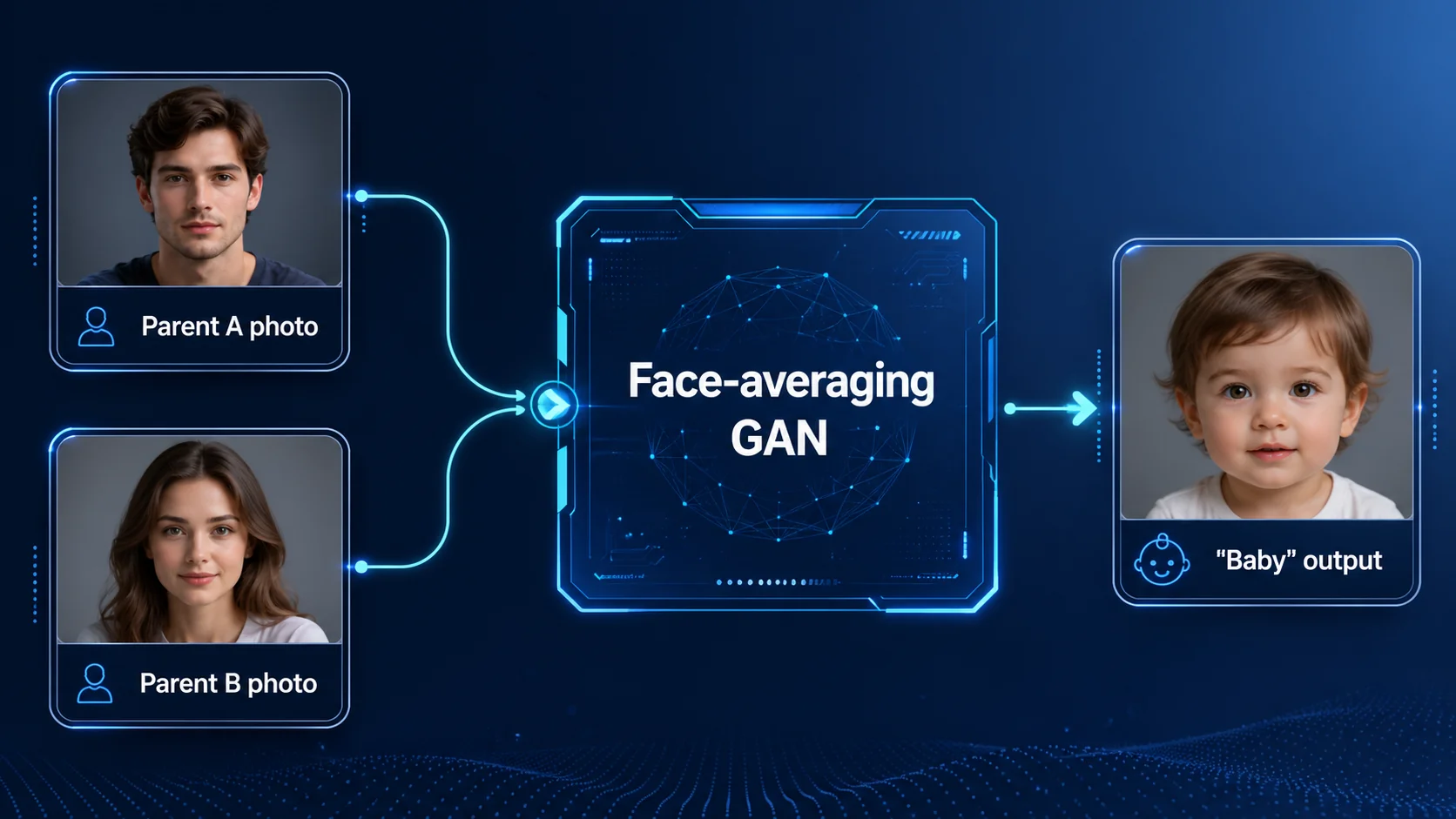
What the model knows about your baby: nothing. The model has never seen your baby. It's drawing on its training corpus of millions of baby photos and producing something that looks like a 50/50 blend of the two adults you uploaded, smoothed into baby proportions and skin texture.
Strengths:
- Fun, instant, entertaining
- Works at any pregnancy stage (or before pregnancy entirely)
- Cheap or free
Limitations:
- The output has no relationship to your actual baby
- Genetics doesn't work like a 50/50 blend — kids inherit features in chunks, not averages, and recessive traits surface unpredictably
- The "baby look" is largely a generic AI smoothing pass, not real prediction
- No explanatory power if your actual baby looks different (which they will)
Ultrasound-driven (real scan in)
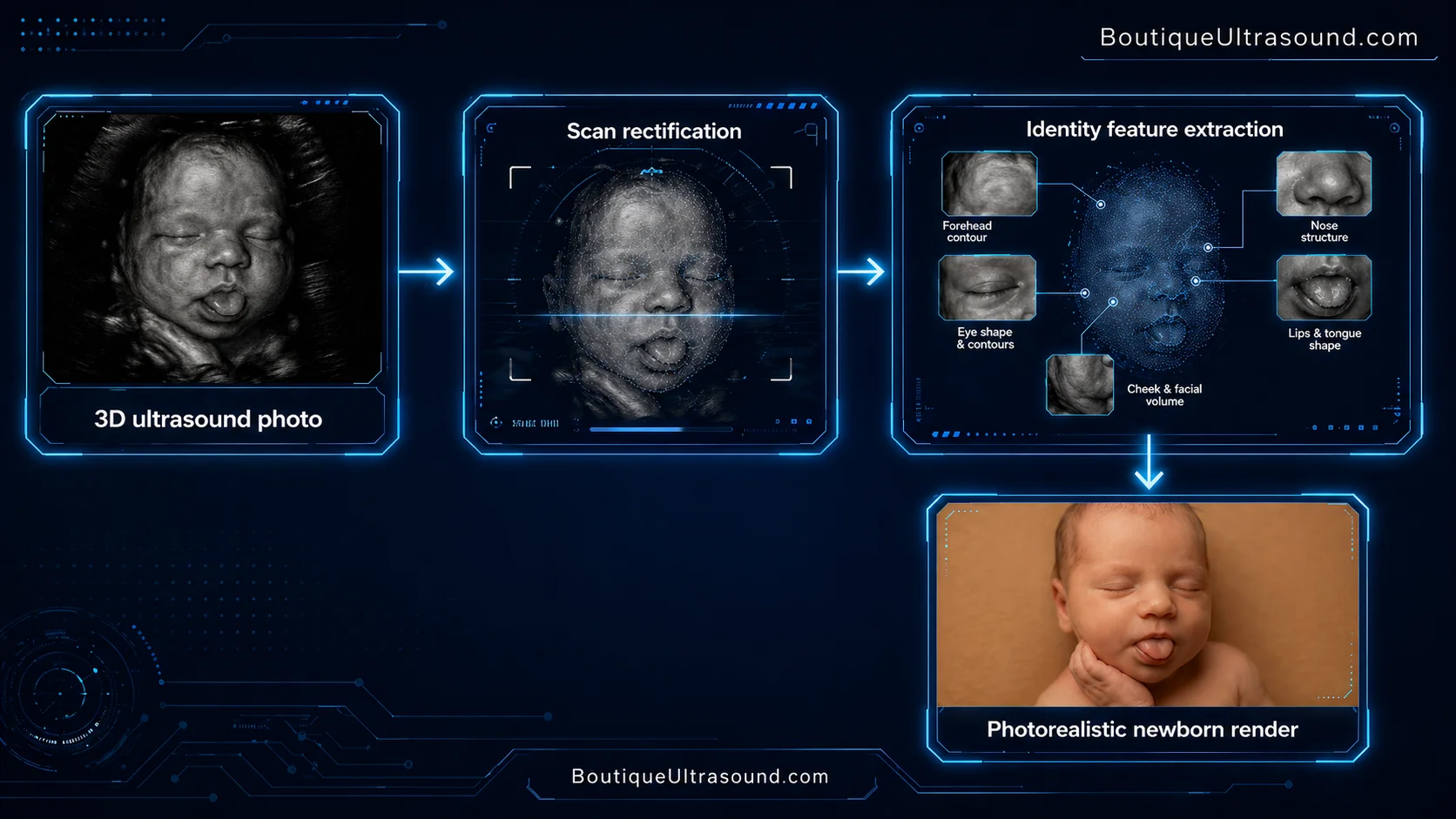
What the model knows about your baby: a lot. It has the actual surface anatomy of your actual baby's face, captured at 26-32 weeks when fetal features are most defined. The render is constrained by that structural data — the AI cannot freely invent a different head shape, because the scan locks the head shape.
Strengths:
- The portrait is a render of a real, specific baby — yours
- Captures real distinctive features (forehead bulge, chin recession, cheek volume) that vary baby to baby
- Provides a true preview of newborn appearance, since the underlying scan was your actual baby
- Honest about what it is (a rendering, not a photograph)
Limitations:
- Requires you to have a 3D ultrasound first (typically week 26-32)
- Less universal than photo-based tools — you need to live somewhere a keepsake studio operates, or visit one
- Output reflects whatever angle and detail your scan captured (if half the face is rotated away from the probe, the AI fills in from anatomical priors, not from invented data)
Side-by-side comparison
| Face-blender (parents' photos) | Ultrasound-driven (real scan) | |
|---|---|---|
| Data about your baby | None | Actual surface anatomy from sound-wave imaging |
| Information source | Two adult faces | A 3D ultrasound photograph |
| Honest output description | "Generic infant rendered to look like a blend of these two adults" | "Photorealistic render of THIS specific baby's features" |
| Captures distinctive features | No — outputs are similar across users | Yes — forehead curve, chin, cheek volume vary |
| Pregnancy stage required | None (works pre-pregnancy) | Typically week 26-32 (when 3D scans are most useful) |
| Studio visit needed | No | Yes — to obtain the source 3D scan |
| Typical cost | Free to $5/photo | $9 single output to $24.99 full bundle (after the studio scan) |
| What it's good for | Entertainment, baby shower games | Real preview of your baby; printed keepsakes; FOMO relief |
| What it's not good for | Predicting actual baby appearance | Pre-pregnancy curiosity |
The "why does this matter" question
There are two reasons you'd want a portrait of your baby before they're born:
Connection. Pregnancy is long. Many parents — especially first-time parents — want a way to feel close to the person growing in there. A 3D ultrasound is amazing for that, but the surface-rendered grayscale image is hard to read; many parents say they can't quite "see" their baby in it.
The reveal moment. Some parents want to print a portrait to share at a baby shower, or send to grandparents, or just hang in the nursery before the actual newborn arrives.
Face-blender apps don't really serve either purpose well. They give you a generic "what could happen" image that any couple with similar features would also get. They're fun, but they're not a portrait of your baby.
Ultrasound-driven AI does serve both purposes — but only if you've already had a 3D scan. That's why most of our customers come to us after their keepsake studio session: they have the scan, but they want a friendlier interpretation of it. Read about when to schedule your 3D ultrasound if you haven't booked yet.
How our pipeline works (the short version)
If you're curious about what actually happens when you upload your scan to Boutique Ultrasound:
- Quality check — we verify the scan is usable (clear enough, fetal anatomy visible). If not, we tell you upfront and don't charge you.
- Scan rectification — we clean up the image: correct perspective, remove fingers/edges/glare from the photo of your printout, isolate the actual scan content.
- Identity extraction — an AI vision model reads structural facial proportions from your specific scan: forehead-to-face ratio, cheek prominence, chin recession, eye orientation. This produces an "Identity Lock" — a numerical fingerprint of your baby's face.
- Photorealistic rendering — a second AI takes that Identity Lock plus the cleaned scan and paints a photorealistic newborn portrait. The angle, expression, and hand position match your scan exactly. The face proportions match your Identity Lock.
- Painterly variants — for our $14.99 and $24.99 tiers, the realistic portrait then becomes the source for 4 artistic renderings (watercolor, dreamy, starry, oil painting), all anchored to the same baby so they look like the same person across styles.
The full process takes about a minute or two — closer to 30 seconds for the single realistic portrait, closer to 90 seconds for the four-style bundle. From $9.
What this is not
We try to be careful with our marketing for two reasons. First, the FDA explicitly warns against framing keepsake ultrasound as medical diagnosis. Second, we don't want to oversell what an AI render can deliver.
So to be specific:
- This is not a medical scan. Your sonographer's diagnostic ultrasound is the medical event. The keepsake studio session is non-diagnostic.
- This is not gender prediction. Newborns at this rendering stage are styled neutral by default — no sex-specific features.
- This is not "guaranteed accuracy." Babies change a lot in the last 8-12 weeks of gestation, and they continue changing for months after birth. Our portrait reflects what your scan captured at 26-32 weeks. By the time your actual baby arrives, they may look subtly different.
- This is not a face-blender of you and your partner. We don't use any photos of you. We only use the scan.
Frequently asked questions
Are AI baby photos accurate?
If "accurate" means "exactly what the baby will look like at birth," then no — but no rendering technology can deliver that. If "accurate" means "constrained by real anatomical data of this specific baby and faithful to the source scan," then yes — ultrasound-driven AI is. Face-blender AI is not, because it has no data about the baby in question.
Can AI predict my baby's face from my photo and my partner's?
No, not in any meaningful sense. Face-averaging two adult faces and smoothing into baby proportions produces something that looks like a baby photo, but it's not a prediction. Genetic inheritance doesn't average parental features — it transmits discrete chunks, and many traits are recessive or dependent on combinations that can't be inferred from two surface faces.
Why do I need a 3D ultrasound first?
Because the AI needs real data about your baby to produce a real portrait of your baby. The 3D ultrasound is the source data. Without it, any "AI baby photo" tool is operating on zero information about your actual child. See our guide on when to schedule a 3D ultrasound and our directory of verified 3D ultrasound studios.
How is this different from the AI baby photo apps on TikTok?
Most TikTok AI baby photo tools are face-blender apps. We're explicitly the other category — ultrasound-driven. If a tool asks for photos of you and your partner instead of an ultrasound scan, it's the entertainment kind, not the portrait kind.
Is this safe? Does the rendering involve another scan?
There's no additional scan involved. You upload a photo of the printed or digital ultrasound your studio gave you. No sound waves, no machines, no exposure of any kind during the rendering. The original scan was your one and only ultrasound for that session, performed by a credentialed sonographer following ALARA guidelines. See our keepsake ultrasound safety page for the full FDA-cited explanation.
What does it cost?
$9 for a single realistic portrait. $14.99 for the realistic portrait + 4 painterly art styles (watercolor, dreamy, starry, oil painting). $24.99 includes those plus an HD upscale and a branded frame for printing. No subscription. See pricing on the AI Ultrasound page.
If you've already had your 3D ultrasound and want to try the other kind of AI baby photo — the kind that actually uses your real scan — start at /ai-ultrasound. If you haven't booked a 3D session yet, browse our directory of verified studios in 9 US cities.