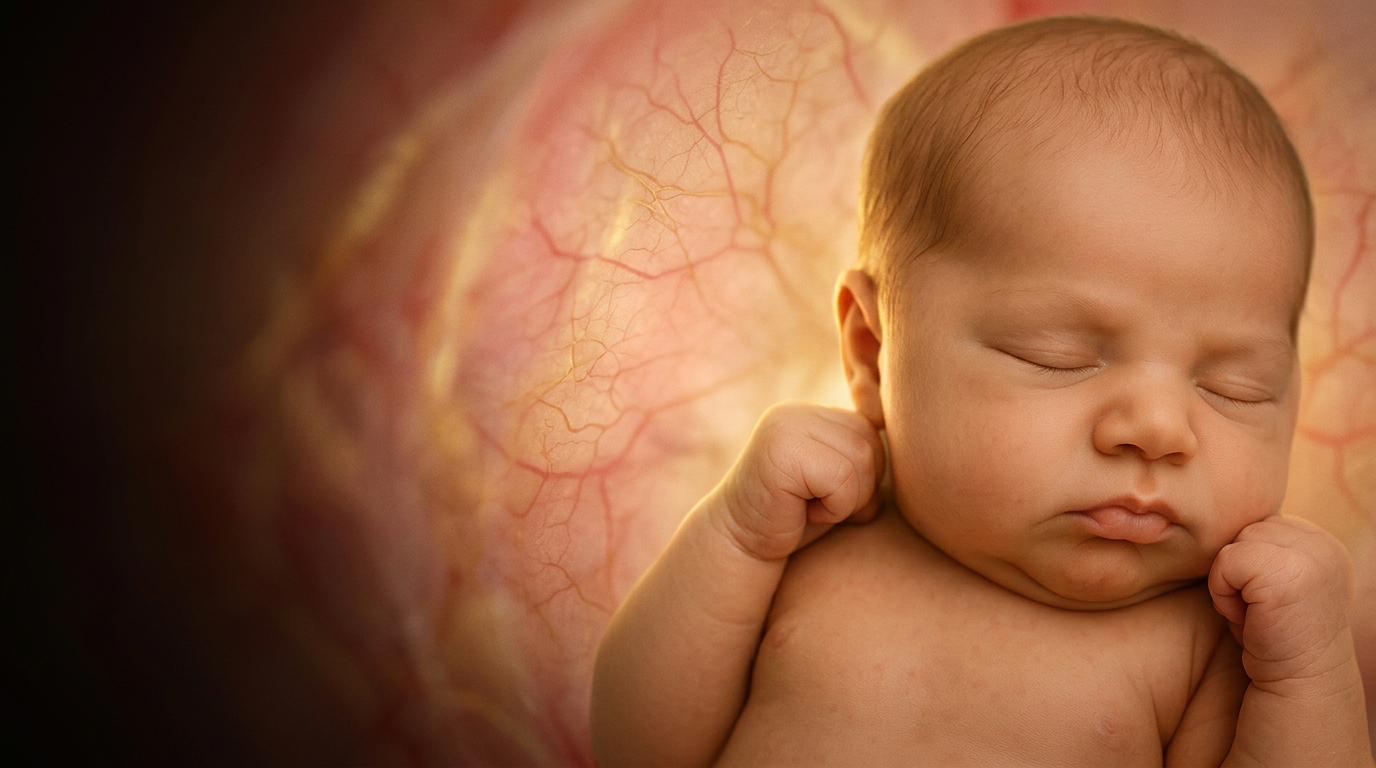
Ultrasound Vision — the method behind 8K Ultrasound.
8K Ultrasound portraits are built on Ultrasound Vision — our ultrasound-specific methodology, anchored by Identity Lock. Below is exactly how it works, grounded in the peer-reviewed fetal-imaging literature — and the limits we're honest about.
Methodology & literature review compiled by meetlaoma · Boutique Ultrasound · 2026
How an ultrasound image is formed.
Medical ultrasound is a pulse-echo system: a transducer emits a short high-frequency pulse (2–15 MHz) and listens for the echoes that return [P1].
An echo forms wherever acoustic impedance (Z = density × speed of sound) changes— at the boundary between tissues — and its strength scales with the impedance difference [P1]. The scanner turns each echo's round-trip time into depth and its amplitude into brightness, building the grayscale B-mode image; stacked planes form the 3-D volume a studio renders.
So a 3-D scan is a grayscale map of sound reflections — carrying no colour, and physically distorted by how sound travels. Everything downstream has to respect that.
Contrast, shadows & clarity.
Sonographers spend most of their effort improving the displayed image. Three battles decide whether a nostril, an eyelid, or a lip edge even exists in the data — and a generic photo-AI fights none of them.
Black–white contrast
Echo amplitudes span a huge range, compressed into the grayscale via gain and dynamic range. The right contrast is what separates the curve of a cheek from the noise around it.
The dark side
Sound attenuates with depth (TGC compensates), and strong reflectors cast acoustic shadows. A dark region may be hidden, not absent — telling those apart is one of the hardest reads.
Clarity & speckle
Sharpness is limited by axial/lateral resolution and the frequency–penetration trade-off; speckle is a coherent interference pattern, not static — so naive smoothing destroys the face with the noise.
Recognise, then render — nine stages.
Quality gate
Scans too degraded to support a faithful portrait are rejected up front — the literature documents that raw fetal scans are limited by noise, movement, field-of-view and occlusion [1][2].
Grounded in · Alomar 2021/22; Sivera 2024
Speckle recognition & correction
Speckle is tissue-dependent and approximately multiplicative — it breaks generic de-noisers, so ultrasound-specific self-supervised methods separate true structure from texture [3].
Grounded in · Speckle2Self, Med. Image Analysis 2025
Shadow / occlusion recognition
We estimate where the image is dark because it is hidden (acoustic shadow, limb, cord) versus genuinely absent — so a hand over the mouth is never hallucinated into a smile [4].
Grounded in · Meng et al., IEEE TMI 2019
Contrast & clarity enhancement
An enhancement stage plays a role analogous to the scanner's TGC and dynamic-range controls — pulling facial structure out of low-contrast and attenuated regions before identity is read.
Grounded in · Imaging-optimization principles [P2][P3]; super-resolution [8]
Landmark recognition
We locate the baby's real eyes, nose and mouth on the source scan — the same fetal-landmark problem studied at MICCAI and in 3DFETUS — and let the studio confirm them [5][6].
Grounded in · 3DFETUS 2025; Xu et al., MICCAI 2020
Identity Lock
The portrait is anchored to those landmarks — to HER face, not an imagined one. Identity preservation is handled as its own module; multiple scans of the same baby (Identity Pack) tighten the lock [7].
Grounded in · Identity-aware CycleGAN
Geometry correction
Because scanners assume a fixed 1540 m/s sound speed, real tissue introduces measurable geometric distortion (a large part of why a nose reads wider on a scan than in life); we correct for it [9].
Grounded in · Bland et al. 2015
Heritage colouring
Grayscale ultrasound contains no colour information at all. Skin tone and hair are a parent-guided artistic choice — never a prediction of the baby's true colouring.
Grounded in · Honesty boundary — no academic basis for colour
Render → up to 8K
Only now do we render on a frontier image model and upscale toward 8K print resolution — the same GAN super-resolution approach validated on fetal ultrasound [8].
Grounded in · Real-ESRGAN on fetal US, Sci Rep 2025
We apply these principles inside a frontier image model — we cite the academic work as the grounding for each stage, not as a description of the exact systems we run.
The limits we're honest about.
- [1]Alomar et al., “Reconstruction of the 3D fetal face from ultrasound.” SCITEPRESS 2021 / Comput. Methods Programs Biomed. 2022.
- [2]Sivera et al., “Fetal face shape analysis from prenatal 3D ultrasound images.” Scientific Reports, 2024.
- [3]Li, Navab, Jiang, “Speckle2Self: Self-supervised ultrasound despeckling.” Medical Image Analysis, 2025.
- [4]Meng et al., “Weakly Supervised Estimation of Shadow Confidence Maps in Fetal Ultrasound.” IEEE Trans. Medical Imaging, 2019.
- [5]Alomar et al., “3DFETUS: Standardising fetal facial planes in 3D ultrasound.” arXiv:2511.10412, 2025.
- [6]Xu et al., “Region Proposal Network with Graph Prior and IoU-Balance Loss for Landmark Detection in 3D Ultrasound.” MICCAI, 2020.
- [7]Huang et al., “Face Translation using Identity-aware CycleGAN.” arXiv:1712.00971.
- [8]Rahman et al., “Enhancing fetal ultrasound image quality… super-resolution.” Scientific Reports, 2025.
- [9]Bland et al., “Geometric distortion of area in medical ultrasound images.” arXiv:1502.04611, 2015.
Imaging physics
- [P1]AAPM/RSNA Physics Tutorial for Residents: Topics in US (RadioGraphics); Radiopaedia — acoustic impedance & B-mode ultrasound.
- [P2]Time Gain Compensation — ScienceDirect Topics; Wikipedia, Time gain compensation.
- [P3]Tissue harmonic imaging, spatial compounding & speckle-reduction imaging — Radiology Key; Resolution & Speckle Reduction in Cardiac Imaging (PMC8034817).
Put Ultrasound Vision to work in your studio.
Add the Identity Lock pipeline to the scans you already take — white-label, same-day, from $39/mo. Pick a plan and start in minutes.