TL;DR
The 20-week ultrasound is your medical anatomy scan — the most important scan of pregnancy from a clinical perspective, performed at 18 to 22 weeks. Your OB or maternal-fetal medicine specialist runs through ~25 anatomical structures to confirm the baby is developing typically.
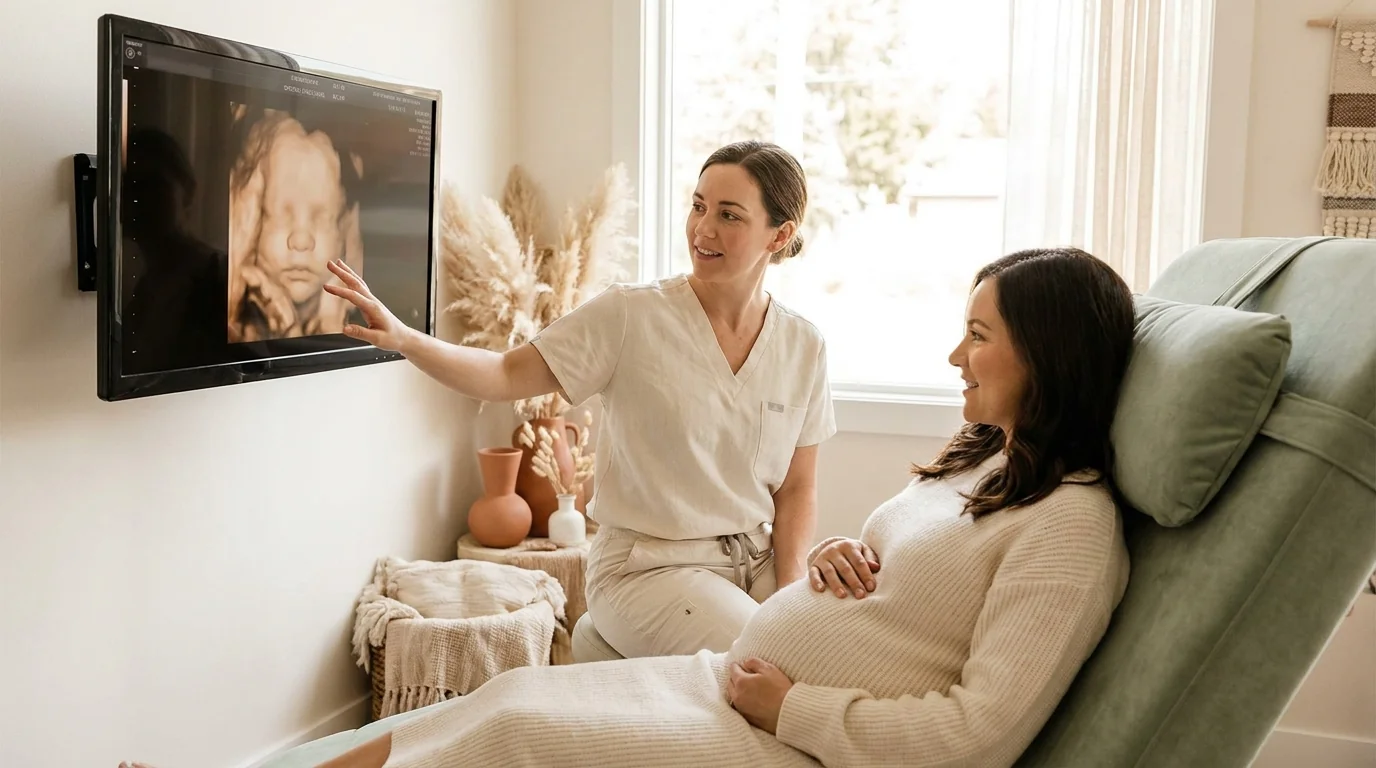
Can it produce a 3D photo? Yes, sometimes — modern machines can render in 3D and many sonographers will switch to 3D briefly if the baby is well-positioned and the parents are interested. But honesty matters: at 20 weeks the baby has very little subcutaneous fat, so 3D images at this stage often look skeletal and a bit alien. The 3D rendering most parents picture in their head — round cheeks, defined lips, sleeping-baby pose — comes from scans done at 26 to 32 weeks, not at 20.
If you want both, the realistic path is: medical anatomy scan now (covered by insurance), keepsake 3D session at 28-30 weeks ($99-$169 self-pay).
What a 20-week ultrasound actually is
The term "20-week ultrasound" is colloquial — clinically it's called the anatomy scan or mid-pregnancy scan, and it's typically scheduled between 18 and 22 weeks. It's the highest-information scan most pregnancies receive and is universally recommended by ACOG and the AIUM.
What the sonographer is actually doing:
| Anatomy structure | What they're checking |
|---|---|
| Brain | Lateral ventricles, cerebellum, posterior fossa, brain symmetry |
| Spine | Full length, neural tube closure, vertebral alignment |
| Heart | Four-chamber view, outflow tracts, rhythm |
| Stomach + bowel | Position, size, presence |
| Kidneys + bladder | Both visible, fluid levels normal |
| Diaphragm | Intact (separates chest and abdomen) |
| Limbs | All four present, correct bone counts, normal proportions |
| Face | Cleft lip / palate screening |
| Genitalia | Sex assessment (if you want to know) |
| Placenta + cord | Location, attachment, three-vessel cord |
| Amniotic fluid | Volume |
It's a thorough scan — typically 30 to 45 minutes. The 3D rendering is not part of the medical workflow. Many sonographers will switch to 3D for 30 seconds at the end if the baby is well-positioned, partly as a gesture for the parents and partly because it's quick. But it's optional and depends on the practice.
Will my OB do a 3D image at 20 weeks?
Maybe. Three factors determine the answer:
- The machine. Most modern obstetric ultrasound machines (GE Voluson, Samsung HERA, Mindray, etc.) have a "3D" button. If your OB's office has any equipment newer than ~2015, the capability is almost certainly there.
- The practice's policy. Some OB practices offer a quick 3D image at every anatomy scan as a goodwill gesture. Others don't — either because the practice is high-volume and there's no time, or because the OB doesn't want to set expectations they can't always meet.
- The baby's position. A baby who is rotated away from the probe, has hands on the face, or is in a position where the placenta blocks the view — won't render well in 3D regardless of equipment. That's a physics issue, not an effort issue.
If 3D is important to you, ask at booking, not at the appointment. "Does your practice typically offer a 3D image during the anatomy scan?" is the right question. The answer tells you what to expect without putting pressure on the sonographer in the moment.
For why most OBs don't push 3D imaging during routine prenatal care, see our deeper take in Why doesn't my OB do 3D ultrasounds?.
Why 3D at 20 weeks often disappoints
Fetal development is uneven. By 20 weeks the baby's bones are well-formed, but subcutaneous fat — the layer right under the skin — is still very thin. That fat is what gives 3D-rendered babies their characteristic round cheeks, plump lips, and sleeping-newborn appearance.
Without it, a 3D image at 20 weeks tends to show:
- Bony, sharp facial features
- Thin "alien-like" arms and legs
- Eyes that look sunken or hollow
- Less of the soft, rounded, newborn-photograph quality
This is not the studio's fault, the machine's fault, or your baby's fault. It's biological timing. Cheek volume comes in fast between week 26 and week 30. That's why keepsake studios consistently recommend booking 3D sessions in that window.
We have a full week-by-week breakdown of what 3D imaging looks like at each stage in Best Week for a 3D / 4D Ultrasound.
Should you book a separate keepsake session?
If you want the full "round-cheeked sleeping baby" 3D photo, yes — and the right time is 26 to 32 weeks. A keepsake studio session at that window will produce dramatically better results than anything possible at 20 weeks.
Cost ballpark:
| Service | Typical 2026 US price |
|---|---|
| Single 3D / 4D keepsake session (week 28-32) | $99–$169 |
| 3D / 4D + HD Live (5D) cinematic upgrade | $129–$199 |
| Two-visit package (gender at 14-16 weeks + portrait at 28-30) | $199–$239 |
Insurance won't cover any of the above (keepsake imaging is non-medical), but the realistic out-the-door cost for a single session with one or two add-ons typically runs $140 to $200. Full breakdown at How much does a 3D ultrasound cost and our deeper 3D Ultrasound Cost 2026 audit.
What you CAN do at 20 weeks (instead of 3D)
If you're at the 20-week appointment and you want something to take home, ask about:
- A printed 2D anatomy image. Most practices will print 1 or 2 black-and-white scan photos for you. They're not the rounded-baby photos but they're a real keepsake from a real medical event.
- A 4D video clip if the baby cooperates. Some practices will capture 30 seconds of 4D video (live motion) at the end of the anatomy scan. The same caveats about thin features apply, but the movement itself can be very meaningful.
- The full anatomy report. Ask the sonographer to walk you through what they're seeing. Most are happy to narrate as they go. This isn't a photo, but it's a kind of live experience that's genuinely educational.
You can also turn a printed 2D ultrasound into an AI-painted realistic newborn portrait — our pipeline accepts both 2D and 3D scans, though 3D produces better results because it has more facial structure data. Cost is $9 single output to $24.99 full bundle.
Booking strategy: get both
The cleanest path most parents end up choosing:
| Week | Visit | Cost | Purpose |
|---|---|---|---|
| 18-22 | Medical anatomy scan (your OB) | $0-$300 (insurance) | Clinical assessment |
| 28-30 | Keepsake 3D / 4D session | $99-$169 | The classic photos + video |
Total time investment: two visits about 8-10 weeks apart. Total cost: insurance copay + ~$130. What you get: medical confirmation that the baby is developing typically, plus the round-cheeked 3D portraits you wanted.
If you want to find a verified 3D ultrasound studio near you, our directory covers 9 US cities with 208 credentialed studios. Most studios book the 28-30 week window 4-6 weeks in advance, so it's worth scheduling around the time of your anatomy scan.
Across our 208-studio US audit, 191 offer 3D sessions and the median published price for a single 3D/4D visit is $105 — almost exactly the "$99 to $169" range you'll see studios advertise, which means budgeting somewhere between an OB copay and a steakhouse dinner is realistic. Only 17 of the 208 don't offer 3D at all, so the booking-availability question is almost never the issue once your anatomy scan is behind you. The cheek-volume question — which is biological, not logistical — is.
Frequently asked questions
Can you get a 3D ultrasound at 20 weeks?
Technically yes — modern machines render in 3D. Practically, the baby has very little subcutaneous fat at 20 weeks, so 3D images tend to look skeletal. The much better window for the rounded-baby look is 26-32 weeks.
Is the 20-week ultrasound the same as a 3D ultrasound?
No. The 20-week ultrasound is a medical anatomy scan that happens to be possible to render in 3D. A "3D ultrasound" in the keepsake-studio sense is a separate, optional, self-pay session focused on producing photos and video, typically done at 26-32 weeks.
Will my insurance cover 3D imaging at the 20-week scan?
Insurance covers the medical anatomy scan when it's medically indicated. The 3D rendering during that scan is incidental — your insurance pays for the underlying scan, not separately for the 3D rendering. If your OB orders a separate 3D scan for medical reasons (rare, e.g., suspected facial anomaly), that's also covered. A standalone keepsake 3D session at a non-OB studio is not covered. See Does Insurance Cover 3D Ultrasound.
Why does the 20-week 3D image look "weird"?
Three reasons: thin subcutaneous fat (so features look sharp/skeletal), small head size (3D rendering favors larger structures), and frequent positioning issues (baby is small enough to face any direction, including away from the probe). All of these resolve by 26-30 weeks. We cover this in detail in Why does my baby look weird in 3D ultrasound.
Can I bring my partner to the 20-week ultrasound?
In most US OB practices, yes — and most will encourage it because the anatomy scan is a meaningful experience. Some practices allow only one support person; some allow grandparents-to-be too. Confirm at booking.
Should I find out the gender at the 20-week scan?
The anatomy scan is the most accurate gender call before birth (99%+). If you want to know, it'll be visible. If you want a surprise, tell the sonographer to skip the genital region and write the result in a sealed envelope (most are happy to do this). For earlier gender determination options, see Gender Ultrasound at 12 Weeks.
How does 3D ultrasound work, technically?
Same low-power sound waves as 2D, but the probe sweeps through a volume of tissue and software reconstructs the surface. The science is identical to 2D — only the rendering differs. Full plain-English explainer: How does 3D ultrasound work.
If you've already had your anatomy scan and are deciding whether to book a separate keepsake session, browse our verified 3D ultrasound studios by US city. If you've already had a 3D scan and want an AI-painted realistic newborn portrait from it, the AI tool starts at $9.