TL;DR
An AI 3D ultrasound to photo is a photorealistic newborn portrait rendered from your actual 3D ultrasound scan. The input is the scan your studio gave you. The output, generated by a diffusion model in about 90 seconds, is a painted baby face anchored to your specific scan — not a face-blended average of two adults, not a stock infant. Single renders run $9 to $24.99 versus $99 to $200 for the studio session that produced the source scan. The two are complements, not substitutes: the studio captures the anatomy, the AI makes the anatomy legible as a face.
If you want the short version: bring your real 3D scan (from any boutique studio, any machine), upload it, choose a style, get a portrait. The technology is new — late 2024 onward — and at the time of writing has exactly two serious vendors. We are one of them. The other ranks #1 on Google for "AI 3D ultrasound" and produced this category of search. The volume is climbing in real time.
What an AI 3D ultrasound photo actually is
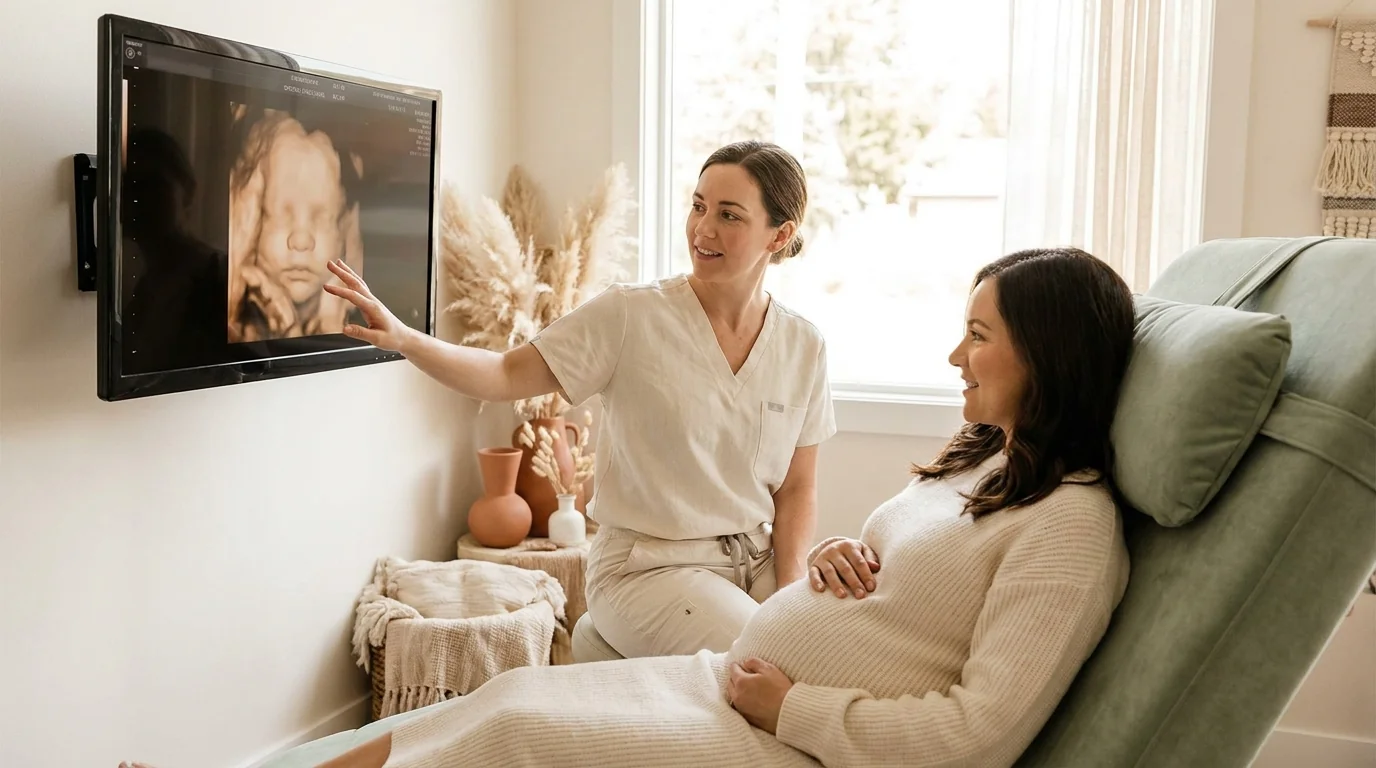
A "3D ultrasound" — the kind a boutique studio captures at 26-32 weeks — is a surface-rendered grayscale image. The transducer fires sound waves, the returning echoes are reconstructed into a 3D volume, and the screen shows you the volume's outer surface: forehead, cheekbones, nose, lips, chin. Many moms find this image hard to read. The baby is there, but the resolution and color depth make it look like a putty sculpture in dim light.
The AI 3D ultrasound to photo pipeline reads that grayscale image as a real source of facial geometry — forehead arc, nose silhouette, chin recession, cheek volume, eye spacing — and produces a photorealistic newborn portrait constrained by that geometry. The model is a diffusion model trained on a corpus of newborn photographs and corresponding ultrasound surface renders, learning the mapping between scan geometry and the smooth, pigmented, full-color face that geometry will become at birth.
Concretely: the AI does not invent a face. It takes the face the scan already captured and paints it in. The same way a courtroom artist sketches from a photograph rather than from imagination, the AI renders from the scan rather than from a parental selfie. This distinction matters because the other big category of "AI baby photo" — the face-blender apps that average two adult selfies into a generic infant — has nothing to do with your actual baby's appearance. We cover that distinction in AI Baby Generator: Ultrasound-Based vs ChatGPT Baby Generator.
Why moms try ultrasound-to-photo
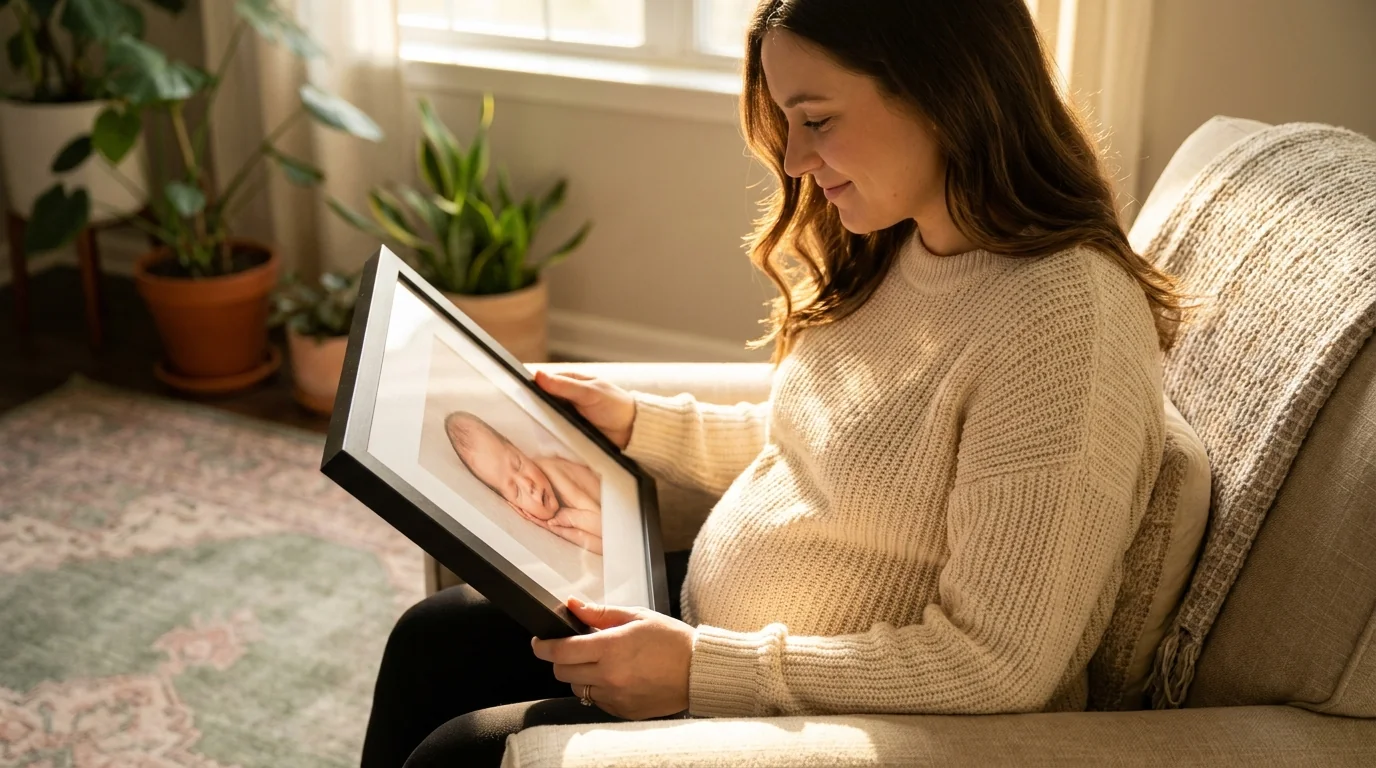
The emotional motivation is direct. A 3D ultrasound is amazing the first time you see it — and then, looking at the printout three days later on the fridge, it can feel less personal than expected. The grayscale rendering reads as anatomy, not as a person. Several recurring use cases come up in mom communities:
- Gender reveal cards and announcement cards. A painted newborn face on a $4 birth-announcement card lands differently than a photocopy of a scan printout.
- Showing grandparents who can't read scans. Older relatives often struggle to "see" the baby in a 3D ultrasound. A painted portrait shortcuts that.
- Nursery printables. A 12 × 18 print of your baby's painted portrait at $9 is meaningfully cheaper than commissioning custom newborn art ($150 to $400 on Etsy).
- Connection during a long pregnancy. Many first-time parents describe weeks 28-34 as a stretch where the baby feels real but visually abstract. A portrait helps.
This is a keepsake category, not a medical one. The portrait is not a prediction about health, gender at birth, or development. It is a translation of the scan you already have into a more readable form.
How accurate is it really?
Honesty matters here, because the technology is new enough that nobody has rigorous before-and-after datasets.
What the AI gets right with high reliability:
- Head and face proportions — forehead-to-face ratio, chin recession, cheek volume, broad/narrow facial structure. These are directly encoded in the scan.
- Distinguishing one baby from another — two different scans produce two different portraits. The model is not collapsing all babies into a single template.
- Surface features the scan captured — if the scan caught a strong nose bridge, the portrait will have a strong nose bridge.
What is more uncertain:
- Skin tone, hair color, eye color — the scan contains no color or pigment data. The model defaults to neutral newborn tones (some shade of pink-tan, eyes shut). Some vendors let you specify ethnicity to nudge the output; we render neutral by default and tell you it's neutral.
- Soft tissue around the eyes and mouth — newborns develop the last 8-12 weeks of facial fat after the 26-32 week scan window. A 28-week scan does not show what a 40-week baby's cheeks will look like. The portrait fills this in from population averages of full-term newborns.
- The very fine asymmetries that make any one face unique — a scan captures the dominant geometry, not every micro-feature.
The honest framing: the portrait is to a 26-32-week scan what a courtroom sketch is to a witness description. It captures the structural truth, but the actual person, when they walk in the room, will have details the sketch could not anticipate. Parents who treat the portrait as "this is approximately what they will look like" are using the tool correctly. Parents who expect a literal photograph are setting themselves up for surprise.
How AI 3D ultrasound photos compare to alternatives
The category has three other adjacent products and one bad alternative. Here's where each one fits:
| Approach | Input | Cost | When you can use it | What you get |
|---|---|---|---|---|
| Traditional 4D studio scan | New ultrasound session | $99-$200 single visit; $199-$239 two-visit package | 26-32 weeks, depends on baby position | Grayscale 3D photos + 4D video, ~5-10 prints |
| AI 3D ultrasound to photo | Your existing 3D scan | $9 single render; $24.99 bundle | After your 3D scan, anytime | Painted newborn portrait in photo + 4 artistic styles |
| Parent-face AI baby generator | Two adult selfies | Free to $5/photo | Anytime (even pre-pregnancy) | Generic infant blended from two adult faces |
| Hand-drawn ultrasound art (Etsy) | Your scan photo | $35-$120, 5-14 day turnaround | Anytime, requires artist availability | One illustrator's interpretation, hand-drawn |
The first two are complements: the studio scan provides the source data, the AI render makes the source data readable. Most of our customers come to us with the scan already in hand and run the AI render as a second step. For comparison shopping on the studio-scan side, see 3D Ultrasound Cost (2026) and How Much Does a 3D Ultrasound Cost? — the median single-visit studio session in our 208-studio audit is $105, and the realistic out-the-door price is $140-$200.
The third — parent-face AI — is a different product entirely, marketed under the same "AI baby photo" umbrella. The ChatGPT GPT "babygpt" currently ranks #1 for the search "ai baby generator." Output is entertaining but has no information about your actual baby. We unpack that head-to-head in AI Baby Generator: Ultrasound-Based vs ChatGPT Baby Generator.
The fourth — hand-drawn art — is the analog version of what AI now does in 90 seconds for ~$10 instead of 1-2 weeks for ~$100. Both have a legitimate market. The hand-drawn version is an artisanal product; the AI version is an instant-keepsake product. Different use cases.
The step-by-step process
The pipeline is short. Here is the canonical workflow at Boutique Ultrasound, plus what to expect at most reputable vendors:
- Get your 3D ultrasound scan. Book a session at a credentialed boutique studio. Optimal timing is week 26-32 (week 24-28 if you have an anterior placenta, since the placenta-in-front-of-baby case captures slightly worse later). Take home the printed photos and the digital file the studio gives you.
- Photograph or upload the scan. A clear photo of the printout works (overhead light, scan flat on a neutral surface, full frame in shot). A direct upload of the digital file works better.
- Upload to the AI vendor. Pick a style — photorealistic, watercolor, oil painting, dreamy, starry — depending on what the vendor offers.
- Receive the portrait in 30-90 seconds. Photorealistic single render is fastest; bundled style sets take longer because the model runs multiple passes anchored to the same Identity Lock.
- Download and print. Standard file is high-resolution JPG suitable for prints up to 11 × 14 inches. Some vendors offer an HD upscale for poster-size printing.
That is the full lifecycle: a single studio visit at the front, an upload, a wait, a download. No second scan. No additional exposure to ultrasound energy of any kind — the rendering is computer vision on the image you already have. We cover the safety implications in detail in the safety section below and in our keepsake ultrasound safety page.
What it costs
The pricing structure for AI 3D ultrasound to photo has settled around three tiers across the two main vendors in this category:
| Tier | Typical price | What you get |
|---|---|---|
| Single realistic portrait | $9 | One photorealistic newborn render |
| Realistic + artistic bundle | $14.99 | Realistic + 4 painterly styles (watercolor, dreamy, starry, oil) |
| Bundle + HD upscale + frame | $24.99 | Bundle + HD upscale for printing + branded digital frame |
These are floor prices. Some vendors charge per render with no bundle option, which adds up if you want both the realistic portrait and the painted version — those typically run $15-$24 for a comparable output set. Some charge a subscription, which we view as the wrong pricing model for a once-or-twice-per-pregnancy product. The $9-$24.99 range corresponds to the right per-render economics for an inferentially expensive AI workflow run a small number of times per family.
Compared to the source studio session ($99-$200), the AI render is in the 5-15% range of the cost. It is meant to sit on top of the studio scan as a small additional purchase, not as a replacement. The studio session is where the source data is captured; the AI render is where the source data becomes a face.
The directory-data angle: why this category is new
Here is the unusual thing about AI 3D ultrasound to photo as a market: the boutique ultrasound industry that supplies the source scans has not yet started bundling AI rendering as an add-on. Of the 208 US boutique ultrasound studios in our current 2026 directory audit, zero list AI portrait rendering as a service tier on their public site. Studios offer 2D, 3D, 4D, HD Live (5D), gender reveal — the conventional service stack — but the AI render lives outside the studio's product set. A category that is searched 50.4 million times in a single SERP query has zero supply integration from the supply side.
That gap is what makes "AI 3D ultrasound to photo" a separately searchable category from "3D ultrasound" itself. A mom looking to get a 3D ultrasound searches "3D ultrasound near me." A mom who already has the scan and wants the painted version searches "ai 3d ultrasound" or "ultrasound to photo." Different intent, different SERP. The AI category is downstream of the studio category by definition — the scan happens first.
Another data point from the same audit: only 32 of the 208 studios (15.4%) publish a verifiable sonographer credential on their public site. AI rendering does not depend on this, because the AI does not need the scan to be from a top-tier studio. A scan from a $50 budget studio renders just as well as a scan from a $200 premium studio. The AI normalizes input across studios — the quality of the painted portrait depends much more on the angle and clarity of the scan than on which machine produced it.
Privacy and safety
Two distinct concerns sit under this heading:
Privacy of the scan image. Your 3D ultrasound is a sensitive piece of personal data. A serious vendor stores the scan only long enough to render the portrait — typically minutes to hours — then deletes the source. We do this; we recommend asking any vendor you upload to about their retention policy and looking for a clear data-deletion statement in their privacy policy. Avoid uploading to vendors that retain the scan to "improve our models" without an opt-out. The ultrasound is not training data.
Safety of the technology itself. This is the easy one: there is no scan involved in the AI render. The AI works on the image you already have. No sound waves, no transducer, no exposure to ultrasound energy. The FDA's safety guidance on ultrasound imaging applies to the original studio scan, not to the rendering step. The rendering is a software process. Our full safety position on the studio scan itself (ALARA, FDA, ACOG, AAFP) is in Are 3D Ultrasounds Safe? and on our safety page.
What this is not, just to be explicit: the AI render is not a medical scan, not a diagnostic image, not a gender prediction (newborns render neutral by default), and not a guarantee of newborn appearance. We market it as a keepsake portrait, which is what it is.
Frequently asked questions
Is "AI 3D ultrasound" the same as "ultrasound to photo"?
Yes, in the current market they refer to the same product category: a real 3D ultrasound scan rendered into a photorealistic newborn portrait by AI. Different vendors use slightly different phrasing. "AI 3D ultrasound" leans on the input format; "ultrasound to photo" describes the transformation. Both surface the same SERP and the same two main vendors.
Can I run AI 3D ultrasound to photo without going to a studio first?
No. The AI needs your actual scan as input. Without a 3D ultrasound, the rendering has no real data about your baby's face — at which point you are using a face-blender app (parents' selfies in, generic baby out), which is the other category. If you have not booked a 3D scan yet, see The Best Week for a 3D Ultrasound and our directory of verified 3D ultrasound studios.
How long does it take to get the AI portrait?
30 to 90 seconds per render. A single photorealistic portrait is on the fast end; bundled style sets that render the same baby across 4-5 artistic styles run longer because the model has to apply the same Identity Lock across multiple passes. Total time from scan-upload to downloaded portrait is typically under 3 minutes.
Will the portrait look like my baby at birth?
The portrait will look like the structural face your 26-32-week scan captured, painted in. Newborns develop the last 8-12 weeks of facial fat after that scan, and they continue developing for months after birth. Treat the portrait as a faithful translation of the scan, not as a photograph of your future newborn. The structural geometry will match; the soft-tissue details and pigmentation will surprise you.
What scan formats work as input?
Any clear 3D ultrasound image: the printed photo a boutique studio hands you, a digital file the studio emails you, or a screenshot taken at the studio. Both straight-on and three-quarter angles render well. 4D video frames work if you can extract a clear still. 2D ultrasounds — the cross-section grayscale scans — do not render well, since the AI is built for 3D surface renders.
Does the AI store my scan?
A responsible vendor stores the scan only long enough to render the portrait, then deletes it. We delete within hours. Check any vendor's privacy policy for a clear data-retention statement. Avoid vendors that explicitly retain scans for model training without an opt-out.
How does this compare to the AI baby photo apps on TikTok?
Most TikTok-promoted "AI baby photo" tools are parent-face blenders — they take two adult selfies and average them into a generic infant. They have no information about your actual baby. AI 3D ultrasound to photo, by contrast, is anchored to your real scan. The output is your baby's facial geometry, painted. See AI Baby Photo from Ultrasound vs Parents' Photos for a detailed head-to-head, or our newer AI Baby Generator: Ultrasound-Based vs ChatGPT Baby Generator for the comparison against the GPT-based tools that dominate the SERP today.
If you have your 3D scan already, start at /ai-ultrasound — single realistic portraits from $9, full bundle from $24.99. If you have not booked the studio session that produces the source scan yet, browse our directory of verified 3D ultrasound studios across 9 US cities, including Los Angeles, Houston, and New York. For the wider category breakdown — what differs between an ultrasound-driven AI render and a parent-face AI baby generator — see our other pillar piece on AI baby generators compared.